
Food loss—which results when food is thrown away despite being edible—was estimated by the Ministry of Agriculture, Forestry and Fisheries to total 5.22 million tons in fiscal 2020 in Japan, and reducing it has become an important societal issue.
Based on the results of our long-accumulated efforts, including improvements in manufacturing methods, we have re-examined the shelf life of our household cooking oil products and subsequently extended the shelf life of our major cooking oil products in plastic bottles, beginning in the spring of 2023. We are also making efforts to do away with the date slot on our “best before” labels and move to a format that displays only the year and month. By using this “year and month” labeling, items that were previously disposed of, because they could not be distributed or consumed as food due to detailed inventory management on a daily basis, could now be distributed and consumed until the end of the month, leading to a reduction in losses such as returns due to delayed product arrival, for example.
In addition to continuing to deliver edible oil products of reliable quality to our customers, we will fulfill our responsibilities as a food business and contribute to the realization of sustainable growth and a sustainable society.
Efforts to ensure long-lasting good flavor with oils and fats
In the field of ready-to-eat meals, the product value of prepared foods such as lunch boxes—even if they can be eaten from a food hygiene perspective—may be impaired due to reasons such as loss of deliciousness and bad appearance, leading to their disposal. We have developed Nisshin Olive Pasta Oil, an exclusive product to solve these issues in pasta cooking, which not only maintains the ease of loosening noodles even after time has passed, but also maintains the glossy surface of noodles and keeps their firm texture without becoming soggy. By utilizing the functions of oils and fats to help develop food products that taste good even after time has passed, we will contribute to solving the social issue of food waste faced by the food industry.
-
Using Nisshin Olive Pasta Oil to maintain
sauce adherence and noodle surface gloss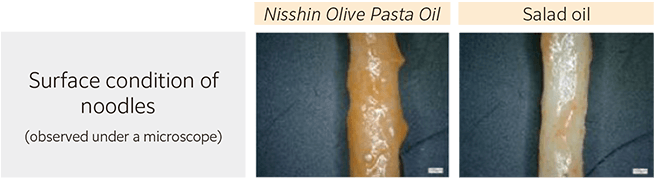
-
Using Nisshin Olive Pasta Oil to reduce expansion over time
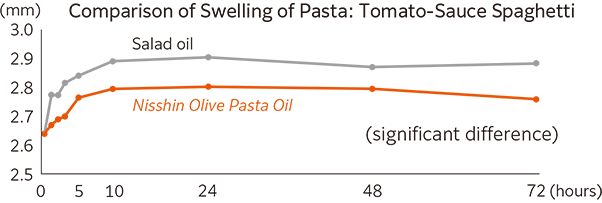
Cooking conditions:
(1) Wash freshly boiled spaghetti in cold water, drain, and then coat the spaghetti with oil. (Amount of oil: 2% of the weight of boiled spaghetti) Proceed with the next steps in cooking the usual Japanese-style “Neapolitan” tomato-sauce spaghetti.
(2) Measure the diameter of the spaghetti at intervals, starting immediately after the “Neapolitan” spaghetti is ready.
Ingredient: Dried pasta (1.6mm spaghettini)