Response to TNFD recommendations

Response to TNFD recommendations

Spotlight

Registering as a TNFD Adopter

We registered as a TNFD Adopter in March 2025. The Nisshin OilliO Group’s business activities are based on plant resources; the very sustainability of our business relies on conserving and restoring the global environment and natural capital. We will continue our earnest efforts to conserve and restore natural capital through our business activities to create shared value with society and achieve the sustainable growth of the Group and the sustainable advancement of society.

(1) Approach to natural capital

  • Plants, animals, soil, water, air, and other forms of natural capital supported by biodiversity are essential to us as the foundation of our social and economic activities. Despite this, we are now losing natural capital faster than ever, and this loss is negatively impacting the global environment. Under these circumstances, we view the loss of natural capital along with climate change as an important social issue for the sustainable future of humanity. We also believe that recognizing and taking measures to address companies’ dependencies on ecosystem services—the benefits they receive from natural capital—and impact on natural capital through their business activities will serve as a driving force for change toward sustainable growth and lead to the healthy development of society and the economy.
  • The Nisshin OilliO Group’s business activities are based on plant resources; the very sustainability of our business relies on conserving the global environment and natural capital. We import our main raw materials—soybean, rapeseed, palm oil, cacao, olive oil, and sesame—from all over the world, and thus depend on certain natural capital and specific production areas. We also recognize that our business activities impact natural capital in the value chain. Therefore, in accordance with The Nisshin OilliO Group Biodiversity Policy, we will earnestly work toward solutions for conserving natural capital through our business activities in an effort to create shared value with society and achieve the sustainable growth of the Group and the sustainable advancement of society.
    The Nisshin OilliO Group Biodiversity Policy
  • Recognizing that natural capital has a substantial bearing on the sustainability of our business, we began analyzing nature-related risks and opportunities in fiscal 2023 in reference to the framework published by the TNFD*1. We will also continue to enhance our disclosures.
  • *1 The Task Force on Nature-related Financial Disclosures (TNFD) is an international organization that has established a framework for private companies and financial institutions to properly assess and disclose nature-related risks and opportunities.

(2) Governance

(2-1) Supervision and execution system

  • Important management issues are deliberated and decided by the Board of Directors. Basic policies, strategies, and measures regarding nature-related issues and other sustainability issues are approved by the Board of Directors after deliberation by the Business Strategy Council, a deliberation body for the execution of business.
  • The Board of Directors is responsible for resolving nature-related issues and supervising progress toward goals. The Board of Directors also collaborates with the Business Strategy Council to proactively resolve issues, obtaining sufficient insight from outside experts when necessary.
  • The Business Strategy Council formulates basic policies to achieve sustainability—the sustainable growth of the Group and the sustainable advancement of society—and deliberates on important issues for realizing our long-term vision.
  • The Management Sustainability Committee* met five times in fiscal 2023. That year, the committee deliberated on The Nisshin OilliO Group Biodiversity Policy and The Nisshin OilliO Group Water Policy, which were established and published that December, and discussed the formulation and announcement of action plans for sustainable procurement of soybean and cacao. The Business Strategy Council reviews nature-related goals and other CSV goals and our priorities, and discusses the establishment of targets for fiscal 2030 on an ongoing basis.
    (*As part of the fiscal 2025 revision of our committee and meeting structure, the Management Sustainability Committee was dissolved.)

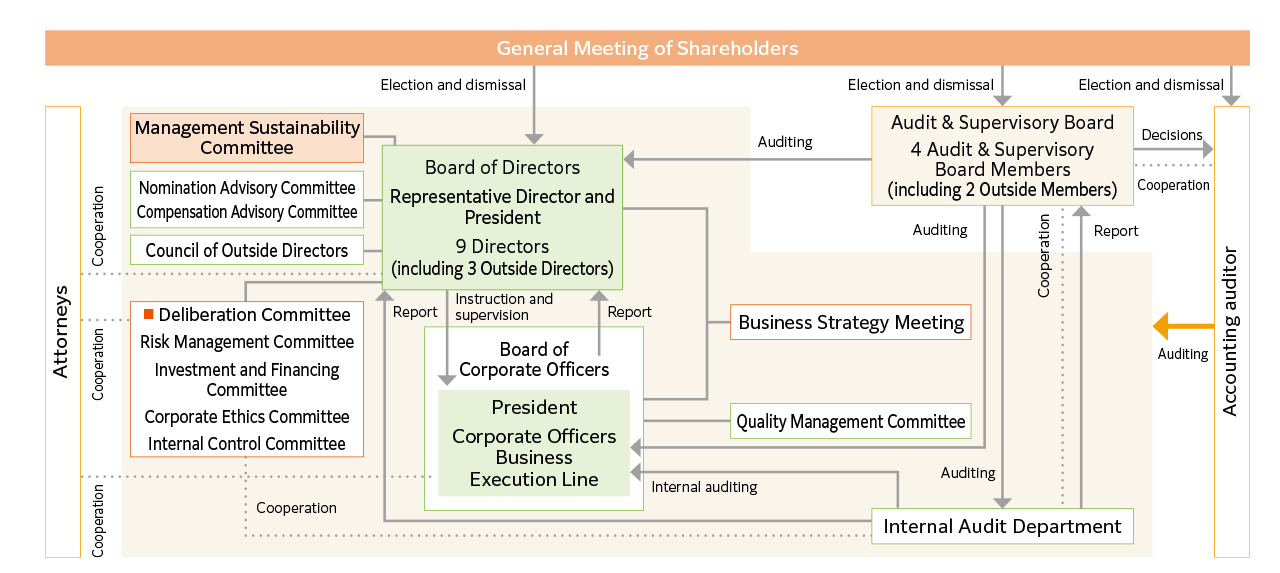
▼ Figure 1: Sustainability promotion structure (from the corporate governance structure chart)

  • 1. The Business Strategy Council is chaired by the president and consists of senior managing officers and managing officers.
  • 2. Standing Audit & Supervisory Board members attend meetings of the Risk Management Committee, the Internal Control Committee, and the Business Strategy Council as observers.
  • 3. Aside from the above, a meeting body has been organized to ensure the effectiveness of auditing through regular information exchange and sharing between standing Audit & Supervisory Board members and corporate staff divisions.

▼ Table 1: Management Sustainability Committee meetings in fiscal 2023

Number of committee meetings 5
Main topics of discussion
  • Review of CSV goals, establishment of new targets for FY2030 (discussed multiple times)
  • Prioritization of risks and opportunities (e.g., identifying new risks and opportunities, reconfirming social issues, verifying priority areas)
  • Response to TCFD recommendations
  • Establishment of Biodiversity Policy and Water Policy
  • Formulation of action plans for sustainable procurement of soybean and cacao

(2-2) Stakeholder relations

  • Using natural capital involves not only its impact on biodiversity, but also the risk of human rights violations. The Group’s governance must take into consideration stakeholders with connections to natural capital. We recognize that our business may directly or indirectly impact human rights in our supply chain. We have established The Nisshin OilliO Group Human Rights Policy to respect the human rights of all people involved in our business, and are promoting group-wide efforts to respect human rights in line with the United Nations Guiding Principles on Business and Human Rights. We respect human rights as defined in the International Bill on Human Rights, the OECD Guidelines for Multinational Enterprises, and the ILO Declaration on Fundamental Principles and Rights at Work. Where there is conflict between internationally recognized human rights and local laws, we will seek ways to maximize respect for the principles of international human rights.
    The Nisshin OilliO Group Human Rights Policy
  • As key human rights efforts, we are establishing a human rights due diligence system for our supply chain and strengthening traceability therein. Additionally, recognizing the importance of efforts throughout our supply chain, we have established The Nisshin OilliO Group Basic Procurement Policy and The Nisshin OilliO Group Supplier Guidelines, and aim to realize and advance a sustainable society through our business activities.
  • As protecting the natural environment and ecosystems in palm oil production areas and respecting the human rights of indigenous people and plantation workers have become social issues, we are also committed to protecting the environment and human rights where our raw materials are produced. Given that each main raw material involves different environmental and social issues, we have established a Palm Oil Procurement Policy, a Soybean Procurement Policy, and a Cacao Procurement Policy to ensure that we realize our Basic Procurement Policy, and will expand and promote sustainable procurement initiatives under action plans to resolve the issues.
    The Nisshin OilliO Group Basic Procurement Policy
    The Nisshin OilliO Group Supplier Guidelines
  • We analyze human rights risks in our supply chain with advice from outside experts. In fiscal 2023, we administered SAQ (Self-Assessment Questionnaire) to roughly 40 high-priority manufacturing contractors in terms of impact on our business, marketability, regional characteristics, and regulatory compliance. We visited two of these contractors to explain The Nisshin OilliO Group Human Rights Policy and engage in dialogue, including exchanging opinions. We will continue to implement these initiatives.

▼ Table 2: Details of SAQ for suppliers

Survey period March 2024
Overview
  • Self-monitored, questionnaire-based written survey
  • Questions about corporate governance, human rights, labor, environment, fair business practices, quality and safety, information security, supply chain, coexisting with local communities, etc.
Results
  • As of the end of April 2024, roughly 90% of suppliers had responded.

▼ Table 3: Details of dialogue with suppliers

Survey period March 2024
Overview Plant visits for in-person surveys

(1) Explained the Group’s environmental and human rights efforts
(2) Examined manufacturing contractors’ environmental and human rights efforts
(3) Plant inspections (in terms of occupational safety and health)

Results
  • At both companies, we found no violations of The Nisshin OilliO Group Supplier Guidelines, which we require our suppliers to comply with.
  • Through dialogue, we sought to ensure that all parties were aware of our policies and requirements.

(3) Strategies

  • In fiscal 2023, we began identifying and assessing nature-related issues (dependencies, impacts, risks, and opportunities) as required for TNFD disclosures. As for specific methodology, we refer to the LEAP (Locate, Evaluate, Assess, and Prepare) approach advocated by the TNFD. The LEAP approach is a process developed by the TNFD as an integrated approach to assessing interface with nature, dependencies and impacts on nature, nature-related risks and opportunities, and more.
  • In fiscal 2023, we identified major dependencies and impacts of the Group’s business on nature, identified risks and opportunities, and listed relevant existing measures. We will continue to use the LEAP approach to identify priority areas, assess risks and opportunities, consider specific measures, and define indicators.

▼ Figure 2: LEAP approach and overview of FY2023 implementation

(3-1) Dependencies and impacts of the Group on nature (Locate, Evaluate)

  • In fiscal 2023, we identified dependencies and impacts on nature from direct operations as well as upstream and downstream value chains of the Group’s Oil and Fat Business and Processed Food and Materials Business. Our upstream value chain includes the production of crops as raw materials and processes such as oilseed processing for palm oil and some other raw materials; this analysis covered the production and processing of our main raw materials: soybean, rapeseed, palm oil, cacao, olive oil, and sesame. As for our direct operations, we manufacture and process the raw materials we procure. In our downstream value chain, our customers manufacture and process the processed products we supply into finished products, which they distribute and retail to end users.
  • The figure below shows interface with nature in the Group’s value chain, and we have identified dependencies and impacts based on these areas.

▼ Figure 3: Interface with nature

* Circles in the figure indicate the locations of main raw material production areas and manufacturing plants

  • To identify dependencies and impacts on nature, we used the ENCORE*3 database recommended by the TNFD to screen for particularly major dependencies and impacts. We listed the main processes and identified the general dependencies and impacts of each in direct operations and upstream and downstream value chains (Tables 4 and 5). We referred to the Global Industry Classification Standard (GICS)*4 to sort out the main processes.
  • *3 Exploring Natural Capital Opportunities, Risks and Exposure (ENCORE) is a tool developed jointly by the United Nations Environment Programme World Conservation Monitoring Centre (UNEP-WCMC) and other organizations under the initiative of the Natural Capital Finance Alliance (NCFA), an international financial industry association for the natural capital sector. ENCORE was introduced in version 1.0 of the TNFD framework as a useful tool for the Locate and Evaluate steps of the LEAP approach.
  • *4 The GICS is a standard jointly developed by US rating agency S&P and Morgan Stanley Capital International (MSCI), a provider of indexes and analytical tools for institutional investors, that classifies the world’s industries into 11 sectors, 24 industry groups, 69 industries, and 158 sub-industries.

▼ Table 4: Dependencies on nature

Value chain Essential ecosystem services (major dependencies)
Supply services Coordination services
Water supply Biomass Genetic resources Other Insect & wind pollination Pest &
disease control
Soil erosion control Natural disaster damage mitigation Consistent rainfall Indoor air circulation through planting, etc. Consistent climate Waste decomposition Soil fertility Air & water purification
Upstream Soy production
Rapeseed production
Olive production
Sesame production
Palm production
Cacao production
Oilseed processing
(olive oil, sesame oil, palm oil)
Direct operations Manufacturing & processing
Downstream Manufacturing & processing
Transport
Sales
  • In the upstream value chain, the production processes for soybean, rapeseed, olives, sesame, palm, and cacao—the raw materials for edible oils and fats—are highly dependent on ecosystem services that support crop production, namely pollination by insects, drought control, and maintaining soil fertility. The functions of mitigating damage from floods, storms, and other natural disasters and controlling soil erosion in farmland are also essential services provided by natural capital.
  • In terms of individual raw materials, cacao production was identified as more dependent on pollinators and more susceptible to changes in natural conditions.
  • Additionally, dependency on water resources was identified in the manufacturing and processing processes of direct operations as well as those of customers in our downstream value chain.

▼ Table 5: Impacts on nature

Value chain Impact factors
Climate change Changes in land, freshwater & ocean use Pollution & decontamination Resource use & replenishment
GHG emissions Terrestrial ecosystems Freshwater ecosystems Marine ecosystems Soil contaminants Water contaminants Solid waste Noise & other disturbances Non-GHG air pollutants Water Other resources
Upstream Soy production
Rapeseed production
Olive production
Sesame production
Palm production
Cacao production
Oilseed processing
(olive oil, sesame oil, palm oil)
Direct operations Manufacturing & processing
Downstream Manufacturing & processing
Transport
Sales
  • In raw material production processes in the upstream value chain, terrestrial ecosystem use and water and soil contamination were identified as impact factors. From the explanations in ENCORE, the documentary records, and other sources of information, we recognize that deforestation for the purpose of developing raw material production areas and excessive use of fertilizers and pesticides in cultivation have a negative impact on nature in terms of the use of terrestrial ecosystems and water and soil contamination.
  • In terms of individual raw materials, palm oil was identified as having an impact on nature due to the GHG emissions, waste, and water use associated with processing.
  • Direct operations have a high potential for impact on nature due to GHG emissions, waste, and wastewater from manufacturing plants during the manufacturing and processing processes. We also identified a high potential for impact on nature in the downstream value chain due to GHG emissions, waste, and wastewater from our customers during their manufacturing, processing, distribution, and sales processes.
  • Important issues in the entire food product manufacturing industry include the food waste from manufacturing and processing processes and products, and the use and disposal of plastic in containers and packaging. Plastics are especially concerning due to GHG emissions from their disposal and incineration, as well as the impact of plastics (microplastics) released into the ocean on marine ecosystems. The Group also recognizes these as important issues.

(3-2) Risks and opportunities (Assess, Prepare)

  • We have identified risks and opportunities associated with particularly large dependencies and impacts of our business on nature. We have also listed our current efforts to address these risks and opportunities.

▼ Table 6: Risks and opportunities arising from dependencies on nature, and existing measures

Natural capital Essential ecosystem services (major dependencies) Value chain Risks Opportunities Relevant Group
environmental target themes
Response (existing measures) AR3T
Upstream Direct
operations
Downstream
Plants & animals Insect & wind pollination
  • Decrease in pollinators
    Capital investment needed for artificial pollination, etc.
  • Procure sustainable raw materials through afforestation and other types of forest conservation
Plant resources/nature conservation
  • Promote sustainability of cacao flavors in Ecuador to boost disease resistance and productivity
Reduce
Restore & Regenerate
Pest & disease control
  • Pests and diseases
  • Promote natural conservation activities by planting mangrove trees in Malaysia, etc.
Restore & Regenerate
Natural disaster (e.g., floods, storms) damage mitigation
  • Increasingly severe floods, storms, and other disasters in raw material production areas
  • Decline in operational capacity due to floods, storms, and other disasters at manufacturing plants
Water Water supply
  • Reduced water supply at manufacturing plants
  • Reduce drought risk and costs through efficient water use during production
Plant resources/nature conservation
Establishing resource recycling
  • Reduce our water consumption intensity at four manufacturing plants in Japan
Reduce
Consistent rainfall
  • Droughts and localized heavy rain
  • Stabilize yields by popularizing dry-/heat-resistant crops
Soil Soil erosion control on farmland
  • Decreased productivity of raw materials due to soil erosion
  • Increase revenues from offering certified sustainable products
  • Improve market valuation by practicing environmentally regenerative farming
  • Acquire new oil and meal resources and functional materials that do not depend on soil
Plant resources/nature conservation
  • Promote procurement of sustainable raw materials (certified palm, certified soybeans)
Avoid
Soil fertility
  • Land deterioration due to raw material production
  • Participate in research group for producing useful substances (e.g., edible oils and fats) obtained from microalgae, and development of food applications and evaluation of their functionality
Transform
Air Consistent climate
  • Increased challenges in ensuring dependable transport
  • Establish a supply chain capable of maintaining product supply in emergencies
Preventing global warming
  • Strengthen BCP to maintain product supply system in emergencies
  • Diversify transport routes for raw materials and products
Reduce

▼ Table 7: Risks and opportunities arising from impacts on nature, and existing measures

Impact factors Value chain Risks Opportunities Relevant Group environmental target themes Response (existing measures) AR3T
Upstream Direct
operations
Downstream
Climate change GHG emissions
  • Tighter regulations for GHG emissions reduction
  • Increased demand for fossil fuel alternatives
  • Reduce transport costs by promoting optimization of logistics for emissions reduction
  • Capture new sales opportunities from demand for fossil fuel alternatives
  • Improve resilience on GHG issues by acquiring new oil and meal resources and functional materials and reducing emissions
Preventing global warming
  • Reduce GHG emissions in the supply chain
  • Promote the use of renewable energy in our manufacturing processes
Reduce
  • Adopt new technologies (e.g., hydrogen energy) that contribute to decarbonization in our manufacturing processes
Avoid
Changes in land,
freshwater &
ocean use
Terrestrial ecosystems
  • Tighter regulations on farmland development and deforestation
  • Increased demand for environmentally conscious raw materials due to tighter regulations
  • Changing consumer preferences
  • Achieve 100% traceability of palm oil to plantations to improve raw material transparency and expand sales opportunities
  • Increase market share and sales by expanding sales of products made from certified raw materials
  • Expand sales opportunities on the strength of increased demand for plant-based foods
Plant resources/nature conservation
  • Promote procurement of sustainable raw materials (certified palm, certified soybeans)
Avoid
  • Promote certification support for oil palm smallholders
Avoid
  • Promote natural conservation activities by planting mangrove trees in Malaysia, etc.
Restore & Regenerate
Pollution &
decontamination
Soil & water contaminants
  • Tighter regulations on pesticide and chemical fertilizer use in raw material production
  • Increase revenues from offering certified sustainable products
  • Improve market valuation by practicing environmentally regenerative farming
Plant resources/nature conservation
  • Promote procurement of sustainable raw materials (certified palm, certified soybeans)
Avoid
  • Promote sustainability of cacao flavors in Ecuador to boost disease resistance and productivity
Reduce
Solid waste
  • Tighter regulations on plastic use and disposal
  • Necessity of developing new technologies to reduce waste generated from manufacturing processes and products
  • Changing consumer preferences
  • Reduce plastic use by introducing recycled and plant-derived materials in food packaging
  • Reduce plastic use by establishing a system for recycling used plastic bottles that contained oil
  • Reduce food loss by extending the shelf life of household cooking oil
  • Create new business by effectively utilizing oil cakes, spent bleaching clay, and other by-products
Establishing resource recycling

Promoting environmentally conscious development
  • Reduce plastic containers/packaging and promote resource recycling
Reduce
  • Promote recycling in our manufacturing processes
Reduce
Non-GHG air pollutants
  • Tighter regulations on emissions
  • Increased impact of acid rain caused by air pollutants
  • Reduce air pollutant emissions by introducing low-emission vehicles
  • Reduce transport costs by promoting optimization of logistics for air pollutant reduction
Preventing global warming
  • Introduce low-emission vehicles for transporting products
Avoid
  • Conduct environmental assessments and provide feedback to delivery companies
Avoid
  • Jointly deliver products, promote modal shift
Reduce
Resource use &
replenishment
Water
  • Conflicts with local communities involving water rights
  • Depletion of water resources
  • Reduce drought risk and costs through efficient water use during production
Establishing resource recycling
  • Reduce our water consumption intensity at four manufacturing plants in Japan
Reduce
  • Dependencies and impacts on natural capital (plants, animals, air, soil, and water) and the risks and opportunities arising from them are closely related to the theme of the Group’s environmental targets; therefore, we are already disclosing indicators, setting targets, and taking action to achieve these targets in due order. In the future, we will further incorporate the issues identified through this approach and enhance our response to steadily progress toward achieving our environmental targets. We will also identify priority areas, assess the significance of risks and opportunities, and take other steps to consider and expand necessary measures, including areas that are not currently being addressed.
  • Additionally, when we respond to risks and opportunities, we are required to take action based on the AR3T Action Framework*5. We will consider additional initiatives based on this framework.
  • *5 A framework proposed by the Science Based Targets Network (SBTN) that prioritizes and organizes corporate actions to minimize negative impacts on nature, reduce nature-related risks, clarify positive impacts on nature, and identify new business opportunities. The AR3T Action Framework requires companies to take action to Avoid, Reduce, Restore & Regenerate, and Transform, in that order.

■ Preventing global warming

  • Because our business operations are based on plant resources, and because climate change has a significant impact on plant growth, responding to climate change is an important management theme. If global warming progresses, increasingly severe meteorological disasters will pose risks to the supply chain, which could cause a decline in production volume and quality of raw materials, threatening their stable supply over the medium and long term.
  • We are streamlining production processes, promoting the use of renewable energy, and taking other steps to reduce Scope 1 and 2 CO2 emissions, and also working to reduce CO2 emissions in our upstream and downstream supply chains. (Relevant indicators: GHG emissions, air pollutant emissions)

▼ Figure 4: Strategic roadmap to promote decarbonization

Sustainability: Our priorities (Global environment)

■ Establishing resource recycling and promoting environmentally conscious development

Measures for plastics

  • We recognize that the use and disposal of plastic in containers and packaging and food loss from manufacturing and processing processes and products are major issues in the food product manufacturing industry. Laws and regulations for conserving natural capital are expected to be strengthened, which may impose additional costs of compliance on the Group’s business as well as the risk of litigation due to inability to comply.
  • We are working to promote resource recycling by reducing plastic use, promoting the use of recycled and plant-derived materials, and developing a recycling system. We are also making efforts to reduce food loss by recycling oil cakes, spent bleaching clay, and other by-products from the manufacturing process within our own manufacturing processes and by extending the shelf lives of our products. (Relevant indicators: volume of waste, volume of containers and packaging)

▼ Figure 5: The Group’s reduction of plastic containers and packaging and promotion of resource recycling

Efforts to reduce and recycle plastics

Measures for water

  • Water is one of the most important forms of natural capital for the Group in the production of raw materials and the manufacturing and processing processes. When a supply chain includes areas of high water stress, there is a high risk of reduced water supply and depletion of water resources, which may increase water procurement costs.
  • We have confirmed that no raw materials for soybean or palm oil are sourced from areas of high water stress, and that none of our main direct operation manufacturing plants take water from areas of high water stress. We will continue to check other raw materials and locations to determine if they are in areas of high water stress, and prepare for risks accordingly. We have also established The Nisshin OilliO Group Water Policy, which promotes the efficient use of water resources in our manufacturing and processing processes and water risk management in our supply chain to conserve water resources. (Relevant indicator: water usage)

    The Nisshin OilliO Group Water Policy

■ Plant resources/nature conservation

  • Our business is based on plant resources; therefore, the very sustainability of our business relies on protecting plant resources and conserving natural capital, and we see these efforts as themes of the utmost priority. Loss of natural capital—the basis for ecosystem services—causes a decrease in pollinators that support crop production, an increase in pest presence, and progressive soil erosion, which in turn lead to the risk of lower crop yields. There is also a risk of increasingly severe damage to the supply chain by floods and storms if coastal forests and other areas are lost. However, given that laws and regulations concerning deforestation and the use of pesticides and chemical fertilizers are expected to be strengthened in the future to reduce negative impacts on nature, our business is also at risk of increased costs associated with compliance, penalties for failure to comply, and a tarnished brand image due to delays in compliance.
  • Regarding soybeans, in line with our Soybean Procurement Policy, we are making efforts to resolve issues throughout the supply chain, including environmental considerations in soybean production areas and continuous monitoring to gain an understanding of actual conditions. We are also a member of the Round Table on Responsible Soy Association (RTRS) and will promote specific efforts, including utilizing certification systems.

    Soybean Action Plan

  • Regarding cacao, we are working on sustainability of cacao flavors, and our subsidiary Daito Cacao Co., Ltd. is engaged in conservation activities for the Arriba variety (a distinctively flavored endemic variety in Ecuador) and is also improving cultivation methods to boost disease resistance and productivity.

    Cacao Action Plan

  • Regarding palm oil, we are planting mangrove trees in Malaysia, a major producer of palm oil. Mangroves make up coastal forests and serve to protect plants, animals, and soil; therefore, conserving them should reduce risks in palm oil production areas. We also engage in sustainable raw material procurement, including obtaining certification from the Roundtable on Sustainable Palm Oil (RSPO). (Relevant indicator: percentage of sustainable raw material procurement)
  • Palm oil has been specifically identified as a source of deforestation, peatland development, violation of indigenous people’s rights, and labor problems in production areas. We recognize the paramount importance of ensuring traceability to plantations for protecting the environment and human rights in palm oil raw material production areas, and are moving forward with action plans to achieve this and resolve the issues. We also believe it is important to identify priority areas for risk countermeasures to further enhance our risk assessment and countermeasures in the future. The following column presents the current status of our efforts.
Column: Moving toward sustainable procurement of palm oil

Palm oil is obtained from a plant known as “oil palm,” which grows in hot and humid tropical regions. Presently, more than 80% of the world’s palm oil is produced in Malaysia and Indonesia. Thanks to high productivity and other benefits, palm oil is an essential raw material for oils and fats in our daily lives, and global production is expanding every year. In the past several years, demand for palm oil has increased not only for food, but also as fuel for biomass power generation.
However, palm oil production has been identified as a source of deforestation, peatland development, and other land modification that negatively impacts nature, violations of indigenous people’s rights, labor problems, and other issues. Failure to address these issues will result in the loss of forests, destroying abundant ecosystems and threatening the livelihoods of indigenous people living near the forests.
Therefore, to satisfy demand for sustainable palm oil procurement, we must gain an accurate understanding of our supply chain and strengthen management by establishing traceability to plantations.

Efforts to identify priority areas

  • The Group has two main palm oil procurement routes: procurement originating from our palm oil refining and processing company in Malaysia (Route A), and procurement through trading companies (Route B). On Route A, we conduct business directly. In contrast, on Route B, trading companies submit to us lists of the palm oil refining and processing companies and oil mills from which they procure palm oil.

▼ Figure 6: The Group’s palm oil procurement routes

  • We also use Global Forest Watch, Google Earth, and other satellite mapping tools to monitor deforestation on a regular basis, which helps us understand problems.

▼ Figure 7: Deforestation in palm oil producing countries identified by satellite mapping tools

  • By overlaying these deforestation areas with the locations of the oil mills we know about, we can identify areas where problems may involve oil mills with which we are associated. This type of analysis will help us identify priority areas within the Group, and we will continue to investigate deforestation and consider responses to major risks.

The Group’s approach and business strategy for palm oil sustainability

  • Palm oil is one of the most important raw materials for the Group, and its use is on the rise. The Group views the rapidly mounting calls for respect for the environment and human rights in the context of palm oil procurement and production as an opportunity for growth. We aim to enhance three types of quality—quality of physical properties (functional aspects), quality of safety and security, and social quality—and make the products and services that combine these qualities the driving force behind the growth of our palm oil business to propel us into a global top provider of oils & fats solutions.

Goals and action plans for sustainable palm oil procurement

  • To resolve environmental and human rights issues in the palm oil supply chain, we engage in dialogue with our plantations, customers, NGOs, and other stakeholders and promote specific initiatives in accordance with the following action plan.

▼ Figure 8: Palm Oil Action Plan

Improving traceability

  • To ensure transparency in the palm oil supply chain, which is exposed to potential risks involving deforestation and labor practices, we are committed to procuring oil certified by the Roundtable on Sustainable Palm Oil (RSPO)*6. The RSPO has four grades of certification; currently, 50% of the palm oil we procure is SG-certified*7. We aim to achieve 100% certification and ensure more than 50% SG certification by 2030. We will also achieve 100% traceability ratio to plantations by 2030, which will serve as the foundation of our action plan.
  • *6 An international organization established in 2004 to transform the market so that sustainable palm oil becomes the standard.
  • *7 SG (Segregated) certification: One of the RSPO certification grades, in which certified oil from multiple certified plantations is passed to the final product manufacturer in a segregated manner from other types of palm oil. SG certification guarantees that 100% of the product is certified.

For more information on these initiatives for palm oil, click the following link to read our March 2024 Sustainable Procurement Report for Palm Oil.
March 2024 Sustainable Procurement Report for Palm Oil

(4) Risk management

(4-1) Risk management approach

  • We define risk as any uncertainty that could have a negative impact on our business and the realization of Vision 2030 and Value Up+ (our medium-term management plan), and we implement risk control accordingly. We aim to fulfill our social responsibility through proactive risk management efforts, achieve stable earnings, and further enhance our corporate value.

(4-2) Risk management system

  • The Risk Management Committee—which was established by the Board of Directors—holistically manages company-wide risks. The committee has identified substantial financial and strategic risks to our business and positioned environmental, human rights, and other sustainability issues as major risks for the Group, which it manages together with other key risks.

(4-3) Methods of identifying and managing risks

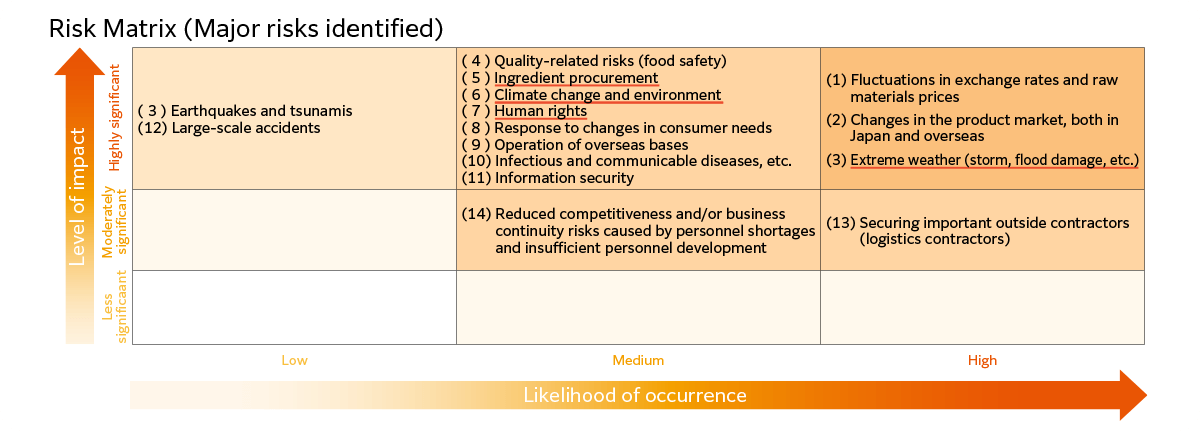
  • The Risk Management Committee inventories risks, creates maps based on the degree of impact and likelihood of occurrence, evaluates and prioritizes the impact of risks when they materialize, and identifies major risks.
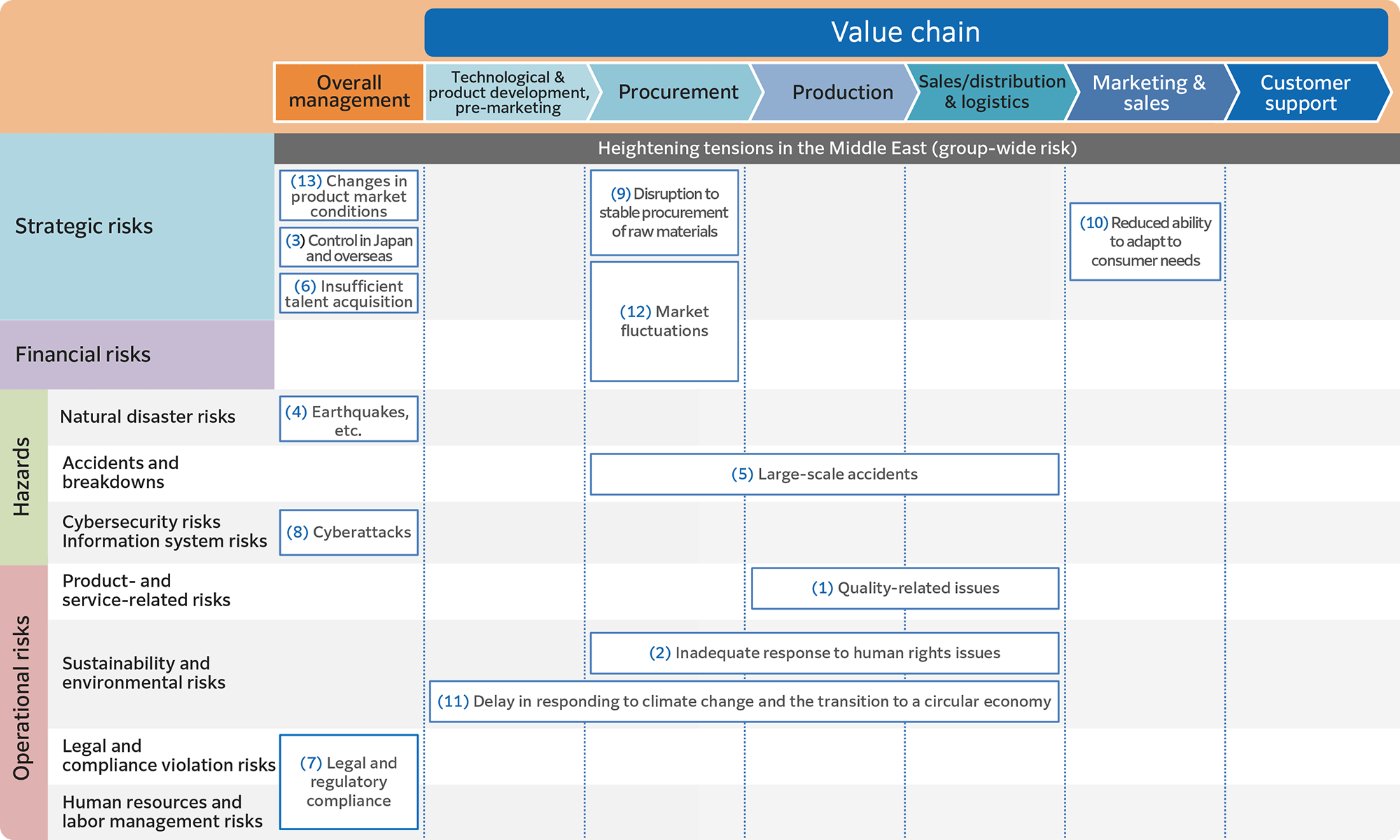
  • In fiscal 2023, the committee identified 14 major risks. Departments in charge took the lead in devising measures and are using the PDCA cycle to manage them. We also have an emergency system for responding to crises when risks materialize.
  • The Risk Management Committee reports their assessment of group-wide risks, policy and status of response, and other matters to the Board of Directors.

(4-4) Major risks for the Group

  • The following figure shows the 14 major risks of the Group identified by the Risk Management Committee.

▼ Figure 9: Major risks of The Nisshin OilliO Group

(5) Indicators and goals

  • The nature-related indicators we publish in our Sustainability Data Book include GHG emissions, air pollutant and chemical emissions, water consumption, volume of waste, volume of containers and packaging (including plastics), and percentage of sustainable raw material procurement. These indicators are also included in the core global indicators recommended by the TNFD for disclosure.
    The Nisshin OilliO Group Sustainability Data Book
  • Our nature-related goals include CSV goals, with “supply chain connected by trust” and “global environment” as priorities for 2030. We are committed to improving the environment, human rights, and sustainability, and will build a stable supply chain for the future in addition to conserving resources and protecting the global environment in order to pass them on to the next generation.
  • We have established Environmental Targets for 2030 in order to realize our CSV goals. Some of these align with the targets of the Kunming-Montreal Biodiversity Framework; for example, our goals for preventing global warming and establishing resource recycling are consistent with the target for preventing and reducing pollution (Target 7). Additionally, our goals for sustainable raw material procurement under “Plant resources/nature conservation” are consistent with the target for managing wild species’ sustainably (Target 9). We have set quantitative targets for these goals, and will continue to set more for other targets in the future.

▼ Table 8: Environmental Targets for 2030

Theme Target  
FY2021 actual FY2022 actual FY2023 actual FY2024 actual Revised target for FY2030
Preventing global warming  Reduce greenhouse gas emissions in the supply chain
  • • Reduce Scope 1 and 2 CO2 emissions
-7.3%
compared with FY2016
-8.6%
compared with FY2016
-18.6%
compared with FY2016
-20.7%
compared with FY2016
-50%
compared with FY2016
  • • Reduce Scope 3 CO2 emissions
  • • Set action targets for emissions reduction
  • • Expanded scope of calculation to include The Nisshin OilliO Group, Ltd., Intercontinental Specialty Fats Sdn. Bhd.
  • • Obtained third-party verification of CO2 emissions
  • • Set quantitative targets for FY2030
  • • Began detailed discussions with US and Canadian industry groups via the Japan Oilseed Processors Association (JOPA) on methods of calculating CO2 emissions from main raw materials (soybean, rapeseed) (September)
  • • Obtained third-party verification of CO2 emissions
  • • Held detailed discussions with Canadian industry groups via the JOPA on methods of calculating CO2 emissions; conducted interviews with Brazilian industry groups
  • • Utilized environmentally conscious vessels (docked at Nagoya Plant in November)
  • • Requested cooperation from suppliers to visualize and reduce CO2 emissions
  • • Obtained third-party verification of CO2 emissions
-25%
(starting with Categories 1 and 4)
compared with FY2020
  • • Implement environmental education and promote the reduction of CO2 emissions through business operations by each and every employee
 Promote the use of renewable energy
  • • Promote the use of renewable energy at the Sakai Plant
  • • Decided to install a solar power generation system at the Sakai Plant
  • • Installed a solar power generation system at the Sakai Plant
  • • Reduced CO2 emissions by 179 t-CO2 through solar power generation at the Sakai Plant
  • • Reduced CO2 emissions by 223 t-CO2 through solar power generation at the Sakai Plant
  • • Reduced CO2 emissions by 476 t-CO2 through procurement of non-fossil certificates equivalent to the electricity used for food product-filling at the Sakai Plant
100%
  • • Expand efforts led by the Sakai Plant to other plants and Group companies
  • • Decided to install solar power generation systems at the Yokohama Isogo Plant and the Nagoya Plant
  • • Installed solar power generation systems at the Yokohama Isogo Plant and the Nagoya Plant
  • • Reduced CO2 emissions by 245 t-CO2 through solar power generation at the Yokohama Isogo Plant and the Nagoya Plant
  • • Reduced CO2 emissions by 275 t-CO2 through solar power generation at the Yokohama Isogo Plant and the Nagoya Plant
Establishing resource recycling  Promote recycling in production processes
  • • Recycling rate in production processes
99.8% 99.8% 99.9% 99.6% At least 99%
  • • Effectively use by-products from edible oil production
  • • Formulated a plan to install a biomass boiler at the Sakai Plant
  • • Installed a biomass boiler at the Sakai Plant
  • • Reduced CO2 emissions by 351 t-CO2 through biomass boiler operation at the Sakai Plant
  • • Reduced CO2 emissions by 468 t-CO2 through biomass boiler operation at the Sakai Plant
 Efficiently use water resources for production
  • • Reduce our water consumption intensity in production activities
-13.1%
compared with FY2016
-15.4%
compared with FY2016
-10.8%
compared with FY2016
-9.5%
compared with FY2016
-14%
compared with FY2016
Plant resources/nature conservation  Promote sustainable raw material procurement
• Promote sustainable palm oil procurement
  • • Increase the percentage of certified palm oil
54.9% (Jan–Dec 2021) 59.6% (Jan–Dec 2022) 66.9% (Jan–Dec 2023) 77.7%(Jan–Dec 2024)
100%
  • • Increase the SG ratio of RSPO certified oil
49.6% (Jan–Dec 2021) 51.1% (Jan–Dec 2022) 56.3% (Jan–Dec 2023) 70.5% (Jan–Dec 2024)
50%
  • • Establish a system to ensure traceability to plantations, aiming for 100% traceability
Palm oil: 68.5%
Palm kernel oil: 30.5%
Palm oil: 90.9% Palm oil: 92.7% Palm oil: 92.9% Palm oil: 100%
  • • Promote efforts to increase soybean sustainability
  • • Conducted a fact-finding survey on Brazilian soybean, considered joining the Round Table on Responsible Soy Association (RTRS), etc.
  • • Established Soybean Procurement Policy
  • • Formulated an action plan based on traceability, Scope 3 emissions reduction, etc.
  • • Began engaging in dialogue with suppliers and producer organizations (in collaboration with JOPA and others, preparing to join RTRS)
  • • Explained the Supplier Guidelines to suppliers and conducted a CSR questionnaire
  • • Began considering soybean procurement that enables the visualization of CO2 emissions during soybean production
  • • Considered procurement of RTRS-certified and traceable soybeans
Sustainable soybean procurement predicated on stable supply
  • • Promote sustainable cacao procurement
  • • Conducted a survey on the conditions of production areas and customer needs
  • • Established Cacao Action Plan
  • • Formulated an action plan based on cacao procurement traceable to plantations, release of products made from certified cacao, conservation of rare beans, etc.
  • • Began procuring Nigerian cocoa beans that are traceable to plantations and are part of environmental and human rights support programs
Sustainable cacao procurement predicated on stable supply
 Promote natural conservation activities
  • • Promote afforestation, etc.
  • • Planted mangrove trees (roughly 0.14 ha, 365 trees) in Malaysia
  • • Planned to expand scale in 2022 and onward
  • • Planted mangrove trees (2 ha) in Malaysia
  • • Planted mangrove trees (1.5 ha, 3,000 trees) in Malaysia
  • • Planted mangrove trees (0.5 ha, 1,000 trees) in Malaysia
Promoting environmentally conscious development Reduce plastic containers/packaging and promote resource recycling
  • • Develop product designs and new containers that reduce plastic use
  • • Discussed the course of action in response to the problems of plastic
  • • Strengthened production system for environmentally conscious containers
  • • Released three paper container products (Canola Oil, Canola Oil Halfuse, and Healthy Sesame Fragrant Oil)
  • • Introduced new containers with 30% recycled PET plastic and 39% less plastic than conventional bottles, released eight new products
  • • Released one paper container product (Light Rice Bran Oil)
  • • Introduced new delaminated “keep fresh” bottle containers (approx. 19% less plastic than conventional bottles), released five new products
  • • Worked with Kewpie to demonstrate that used PET bottles that once contained oil can be recycled into product containers
  • • Introduced partially recycled PET plastic in the household-use category (200-g PET bottles), released two new products
  • • Development and realization of systems for containers, technologies, and services conducive to resource recycling
  • • Reduction ratio of petroleum-based plastic used for containers (bottle/cap): 15% (compared with FY2022)
  • • Develop easily recyclable containers and technologies to facilitate recycling, and establish a recycling system
  • • Decided to invest in an environmentally conscious container filling line at the Sakai Plant
  • • Collaborated with the City of Kawasaki on an experiment to collect used plastic containers for edible oil and seasonings from households
  • • Promote the use of recycled materials and plant-derived materials as alternatives to facilitate recycling
  • • Planned to introduce biopolyethylene in products in the household-use category (1,000-g polyethylene bottles)
  • • Introduced biopolyethylene in products in the household-use category (1,000-g polyethylene bottles)
 Develop products/services that use plant resources and have a positive environmental impact
  • • Develop products and applications that have a positive impact on the environment in the food and industrial domains
  • • Developed 10 products that have a positive environmental impact
  • • Developed new approaches and proposals for industrial applications (e.g., lubricants, inks, adhesives)
  • • Developed 15 products that have a positive environmental impact
  • • Cumulative: 41 products
  • • Developed and released long-lasting oils, plant-based industrial oils and fats, etc. for reducing food loss
  • • Cumulative: 54 products
  • • Expanded adoption of our products as mineral oil substitutes and in other new industrial applications; promoted development of products that contribute to food loss, plant-based and environmentally conscious cosmetic ingredients, etc.
Products/services that have a positive environmental impact become the core driving force of growth

▼ Table 9: CSV goals for our priorities

Priorities CSV goals Results in each fiscal year
FY2030 FY2021 FY2022 FY2023 FY2024
Good health for all Vision: Underpinning the era of 100-year lifespans by contributing to mental and physical health
Specific effort: Provide products and services that utilize our extensive knowledge of lipid nutrition
Increase the growth rate of health science products*1 that generate health and energy at different life stages (compared with FY2019) 200% 112% 127% 133% 143%
Develop products to improve health issues by utilizing our lipid nutrition knowledge*2 Acquire evidence and develop products for resolving personal health issues (improving and controlling physical condition) Released new foods with functional claims Launched 11 products, including food with the functional claim of “reducing body fat and waist size” and nutritional supplements
  • Acquired six pieces of evidence involving “fat burning” burning and preventing undernutrition and frailty (MCTs)
  • Released nine products, including small-quantity, high-energy products
  • Acquired five pieces of evidence involving “fat burning,” preventing frailty (maintaining leg muscle strength of middle-aged and elderly people), reducing fatigue, etc.
  • Released or updated six products promoting “fat burning,” nutritional supplementation, etc.: 35 products in total since FY2022
Expand the number of people provided with health information to promote optimal lipid intake (cumulative total since FY2021)*3 Cumulative: 400 million 8.08 million Cumulative: 34.84 million Cumulative: 89.41 million Cumulative: 150 million
Quality of life Vision: Contributing to the realization of a more enhanced quality of life through the pursuit of Good Flavor and Beauty
Specific effort: Provide oils & fats as our products and services that offer Good Flavor and Beauty
Refine brands to offer a higher quality of life through Good Flavor for foods Corporate brand awareness: 90% Promoted the creation of new flavored oil categories Promoted the development of products that utilize the Company’s specialized technologies Released Nisshin Healthy Clear, made with our ultra oxidation barrier manufacturing method that thoroughly inhibits oil oxidation, in spring 2024 Released new products that taste good and are healthy and otherwise enjoyable to counter the expanded rice bran oil market, soaring olive oil prices, etc.
Create products that pursue Good Flavor and Beauty Further contribute to food enrichment by creating new categories based on edible oils Released flavored oil products Launched six flavored oil products as products to spread a new way of using oil to add flavor Expanded awareness by introducing new flavored oil products and developing promotions (awareness: 25%)
  • Introduced new products to revitalize the flavored oil market
  • The flavored oil market size: 168% YoY
Increase the growth rate of beauty-enhancing products*4 (compared with FY2019) 200% 105% 127% 126.6% 146%
Global environment Vision: Tackling challenges to pass on the global environment to the next generation
Specific effort: Maintain a planet where plants can grow and people can live healthy lives
Reduce Scope 1 and 2 CO2 emissions (compared with FY2016)*1 50% 7.3% 8.6% 18.6% 20.7%
Reduce Scope 3 CO2 emissions (compared with FY2020, starting with Categories 1 and 4) 25% Calculated the past results and set targets for FY2022 and beyond Promoted the setting of quantitative targets in collaboration with the Japan Oilseed Processors Association (JOPA) for ensuring reductions in CO2 through the Canada-Japan Canola Consultations and the U.S.-Japan Partnership program
  • Set quantitative targets for FY2030
  • Began detailed discussions in September with US and Canadian industry groups via the JOPA on methods of calculating CO2 emissions from main raw materials (soybean and rapeseed)
  • Held detailed discussions with Canadian industry groups via the JOPA on methods of calculating CO2 emissions; conducted interviews with Brazilian industry groups
  • Utilized environmentally conscious vessels (docked at Nagoya Plant in November)
  • Requested cooperation from suppliers to visualize and reduce CO2 emissions
Reduce plastic containers/packaging and promote resource recycling
  • Develop and realize systems for containers, technologies, and services conducive to resource recycling
  • Reduce ratio of petroleum-based plastic used for containers (bottle/cap) made from petroleum: 15% (compared with FY2022)
Discussed our course of action and decided on relevant investments
  • Introduced bio-polyethylene into some of the household-use products (1,000 g)
  • Enhanced our environmentally conscious container production system
  • Released three paper container products (Canola Oil, Canola Oil Half-use, and Healthy Sesame Fragrant Oil)
  • Introduced new containers with 39% less plastic than conventional bottles and partially made from recycled PET plastic, and released eight new products
  • Achieved a 52% introduction rate of environmentally conscious materials in products in the household-use category
  • Reduced ratio of petroleum-based plastic used for containers (bottle/cap) by 3.9%
Develop products/services that use plant resources and the Company’s technology and have a positive environmental impact (cumulative total since FY2021) Make products/ services that have a positive environmental impact become the core driving force of growth 10 products Cumulative: 28 products/services Cumulative: 41 products/services
(Developed and released long-lasting oils, plant-based industrial oils and fats, etc. for reducing food loss)
Cumulative: 54 products/services
Expanded adoption of our products as mineral oil substitutes and in other new industrial applications; promoted development of products that contribute to food loss, plant-based and environmentally conscious cosmetic ingredients, etc.
Contribution to the food value chain Vision: Working with customers to refine our technologies, products, and services for enhanced value
Specific effort: Refine technologies, products, and services together with customers
Stably supply food energy in Japan (percentage of total domestic energy) 6% or more 7.5% 7.5% 7.3% 7.6%
Provide solutions by demonstrating product application development functions
Increase the number of cases (compared with FY2019)
150% 83% 112% 127% 131%
Make other efforts, progress, and results - - Started extending the shelf lives of some products in the household-use category from 18 months to 25 months in spring 2023 Began participating in industry-academia-government collaboration projects to acquire new meal resources and functional materials (development of alternative algae-based lipids) Began operations of Incubation Square, a hub for co-creation with customers, in May (Number of visits: 161)
Supply chain connected by trust Vision: Building a strong, resilient supply chain that values integrity
Specific effort: Contribute to building a sustainable supply chain from upstream to downstream
Advance and fortify business operations based on respect for human rights Lay the groundwork and establish mechanisms to prevent human rights violations in the supply chain - Disseminated our human rights policy throughout the Group, and began operations on human rights due diligence Established Supplier Guidelines, began providing guidance to high-priority suppliers, administered an SAQ*6 and made site visits to manufacturing contractors Administered an SAQ to high-priority suppliers and logistics providers of soybean, rapeseed, and palm oil
Improve traceability to plantations Palm oil:
100%
Palm oil:
68.5%
Palm oil:
90.9%
(January–December)
Palm oil:
92.7%
(January–December)
Palm oil:
92.9%
(January–December)
Promote sustainable soybean procurement Sustainable soybean procurement predicated on stable supply Conducted a fact-finding survey and considered joining the RTRS*7 Formulated and announced a Soybean Procurement Policy
  • Formulated an action plan based on traceability, Scope 3 emissions reduction, etc.
  • Began engaging with suppliers and producer organizations (collaborated with the JOPA and other organizations and prepared for joining the RTRS)
  • Explained the Supplier Guidelines to suppliers and conducted a CSR questionnaire
  • Began considering soybean procurement that enables the visualization of CO2 emissions during soybean production
  • Considered procurement of RTRS-certified and traceable soybeans
Promote sustainable cacao procurement Sustainable cacao procurement predicated on stable supply Conducted a survey on the conditions of production areas and customer needs Formulated and announced a Cacao Procurement Policy Formulated an action plan based on cacao procurement traceable to plantations, release of products made from certified cacao, conservation of rare beans, etc. Began procuring Nigerian cocoa beans that are traceable to plantations and are part of environmental and human rights support programs
Establish a sustainable, competitive logistics system Increase the F-LINE co-distribution rate to make transport and loading more efficient 30% - 14% 14% 14%
Reduce the truck drivers’ time spent at Company plants Average: Within 30 minutes - Average: 88 minutes (as of March 2024) Average: 65 minutes (as of March 2025)
Human resource management Vision: Enhancing fulfillment among diverse human resources to improve organizational capacity and drive innovation
Specific effort: Improve the organizational capabilities and job satisfaction of diverse human resources
Resonate with the Group’s philosophy and vision Increase the resonance index for the Group’s Corporate Philosophy and Vision 2030 (★) 95% or more of employees resonating
25% or more of core group resonating strongly
- 93.9% of employees resonating
13.3% of core group resonating strongly
Build a strong workforce Maintain and expand annual training and education expenditure per full-time employee as a proactive investment in human resource development ¥95,000 or more ¥34,000 ¥52,000 ¥78,000 ¥72,000
Leverage diverse talent Expand employees’ growth-oriented mindset and sense of growth through work (★) Growth-oriented: 95% or more
Sense of growth: 90% or more
- Growth-oriented: 95%
Sense of growth: 80.5%
Increase the percentage of management positions held by women (non-consolidated)*8 20% 5.0% 6.3% 7.3% 8.4%
Evolve into an organizational culture that creates innovation Increase the percentage of employees who feel fulfilled at work 80% or more - 69.9%
Reference: Non-consolidated Company figures 64.6% 63.0% 65.5% 68.7%
  • *1 MCT oil and processed foods, healthy oils, supplement-type oils, wellness foods, and other products that can contribute to measures against lifestyle-related diseases/disorders, frailty, and other maladies.
  • *2 Products that can contribute to resolving undernutrition, overnutrition, and personal health issues.
  • *3 Health information about lipids refers to information that helps improve on undernutrition and overnutrition and resolve personal health issues, and leads to correct understanding and increased value of oils and fats.
  • *4 Cosmetic ingredients (including products of IQL and NOST), health and sanitation management business of Settsu Inc.
  • *5 Calculated using the latest emission factor at the time of drafting the report.
  • *6 SAQ: Self-Assessment Questionnaire
  • *7 RTRS: Round Table on Responsible Soy Association
  • *8 Base date: April 1 of the following fiscal year.